
Sleep Debt Calculator
Enter how much you actually sleep and this sleep debt calculator totals the gap against your recommended hours, in hours and complete 90-minute cycles.
- CDC recommended hours
- 90-min cycle math
- Free · No sign-up
How to use the Sleep Debt Calculator
Log a week of sleep and see what you owe — free, no sign-up, nothing to install.
Log your week
Switch to the weekly sleep log and set the hours you slept each night — days below your age group's target are flagged as you go.
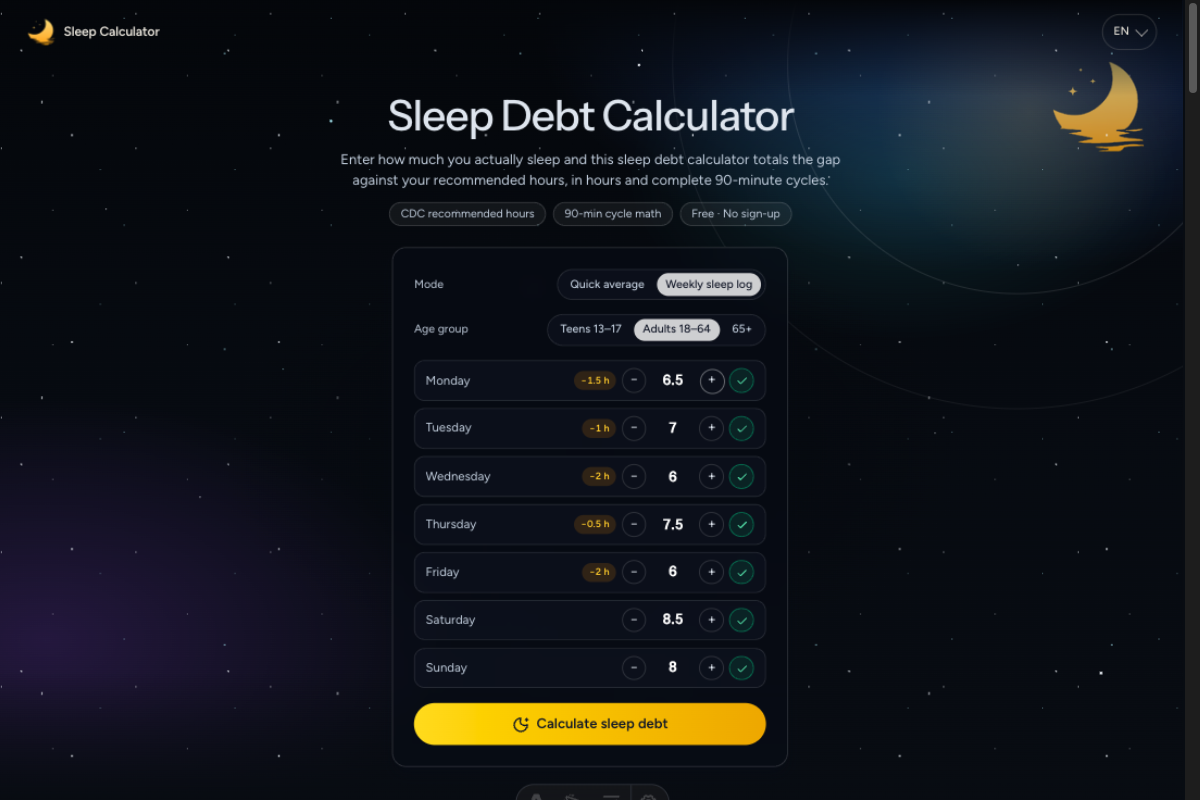
Five of this week's seven nights fell below the adult target of 7–9 hours. See your sleep debt
Tap Calculate sleep debt and the shortfall adds up instantly, in hours and ninety-minute cycles, with a verdict and repayment advice.
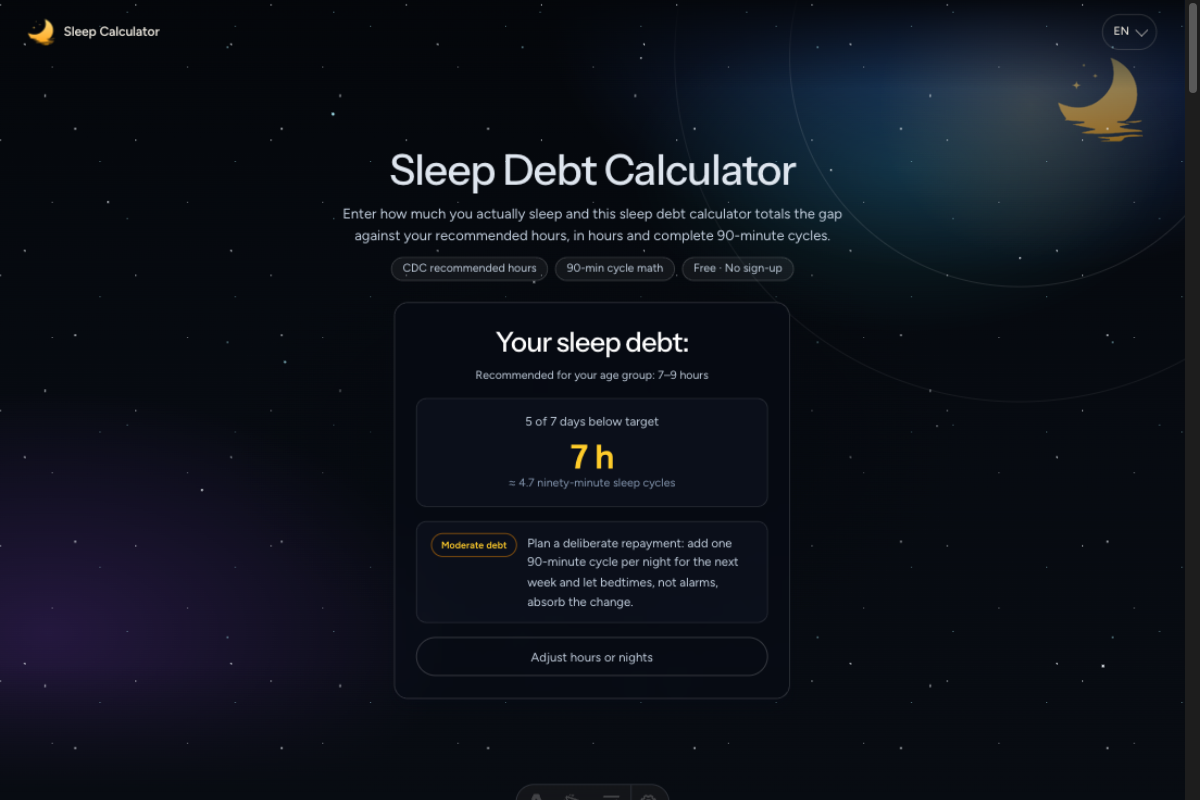
This week ends 7 hours short — a moderate debt of about five sleep cycles. Pay it back gently
Add one cycle per night — about ninety minutes — and let the number turn green, instead of trying to erase it in a single weekend.

Sweet dreams — steady nights clear the debt while the moon keeps count.
What sleep debt is
Sleep debt is the running total of the sleep you needed but did not get. If your body runs best on eight hours and you sleep six and a half, every night leaves a one-and-a-half-hour shortfall — and a week of those nights leaves roughly ten hours of debt. The idea matters because the shortfall compounds quietly: performance, mood and reaction time keep sliding across a short week even when each individual night looks almost acceptable. Sleep debt is not a diagnosis, it is an accounting of a gap, which is exactly what makes it useful for planning.
How to calculate sleep debt
The sleep debt formula is simple: recommended hours minus actual hours, multiplied by the number of nights. Sleep six hours for seven nights against an eight-hour target and the arithmetic is (8 − 6) × 7 = 14 hours of debt. Two details make the number honest rather than alarming. First, use your recommended range, not a mythical fixed eight hours — the range for most adults is seven to nine hours, so someone who genuinely thrives on seven accumulates far less debt than the raw formula suggests. Second, count hours asleep, not hours in bed; if you lie down for eight hours but sleep six and a half, the gap is against the six and a half.
How this sleep debt calculator works
The calculator offers two ways to measure the same gap. The quick average mode takes your average hours asleep and multiplies the daily shortfall by the nights you tracked. The weekly sleep log covers the past seven days, Monday to Sunday: you enter each night separately and the calculator applies the sleep debt formula to every one of them — each day contributes max(0, target − actual) hours, so days below target add debt, days above target add nothing, and days you switch off do not count at all. Both modes read the target from the middle of the recommended range for your age group, the same CDC table used across this site. The result appears as hours of debt, and converted into ninety-minute sleep cycles, because that is the unit the rest of this site plans in — a debt of ten and a half hours is about seven cycles you did not finish. The verdict bands are deliberately coarse: no debt at or above target, mild under about four hours, moderate up to about twelve, and heavy beyond that. They describe the size of the gap, not your health.
Can you catch up on sleep?
Partly, and slower than weekend logic suggests. Recovery sleep does repay some of what was lost: studies of restricted sleep followed by several nights of recovery find that alertness and reaction time climb back substantially, and a long lie-in genuinely helps a short-term deficit. But two limits matter. A weekend does not undo a week of debt on a hour-for-hour basis, and late weekend mornings shift your body clock later, which makes Monday's alarm feel like jet lag. The practical middle path: repay most of the debt with earlier bedtimes spread across the week, keep the weekend lie-in to an hour or so past normal, and anchor the whole schedule to a consistent wake-up time.
Repaying debt in sleep cycles
Because this site plans sleep in ninety-minute cycles, repayment is easiest to schedule in the same unit. One extra cycle per night is 1.5 hours — over a week that is ten and a half hours, which erases most moderate debts without a single heroic night. The bedtime calculator is the tool for this: fix your alarm, count backwards, and pick a bedtime one cycle earlier than usual. If an earlier bedtime is not realistic, a short evening nap or an earlier lie-down on lighter days distributes the repayment instead. What repayment cannot do is compress: you cannot bank a month of eight-hour nights in advance, and one twelve-hour weekend does not replace a routine.
Where the recommended hours come from
The target range in the calculator comes from the CDC's summary of the American Academy of Sleep Medicine consensus recommendations, the same table shown on the sleep calculator by age page: eight to ten hours for teenagers, seven to nine for adults up to sixty-four, and seven to eight from sixty-five onwards. The calculator uses the middle of the range as its target so the debt estimate stays conservative — if your personal need sits at the low end of the range, your true debt is smaller than the tool reports. For children, where naps count toward the total, run the numbers on the by-age page instead.
Limits of a debt estimate
Self-reported hours are estimates, and people systematically overestimate how long they sleep. The calculator measures a gap against a population average, not against your measured sleep; it cannot see sleep quality, disorders, or how rested you feel. If you sleep long hours and still wake exhausted, or if daytime sleepiness persists despite a full repayment plan, treat that as a reason to talk to a clinician rather than a reason to add more cycles.
Weekly sleep debt by hours slept
The gap seven nights leave against an eight-hour adult target, with each total converted into ninety-minute cycles.
Weekly debt for an adult target of 8 hours: (8 − hours slept) × 7 nights, and the same gap expressed in 90-minute cycles.
- You sleep
- 5 hours
- Weekly gap
- 21 h
- ≈ 90-min cycles
- 14
- You sleep
- 5.5 hours
- Weekly gap
- 17.5 h
- ≈ 90-min cycles
- 11.7
- You sleep
- 6 hours
- Weekly gap
- 14 h
- ≈ 90-min cycles
- 9.3
- You sleep
- 6.5 hours
- Weekly gap
- 10.5 h
- ≈ 90-min cycles
- 7
- You sleep
- 7 hours
- Weekly gap
- 7 h
- ≈ 90-min cycles
- 4.7
- You sleep
- 7.5 hours
- Weekly gap
- 3.5 h
- ≈ 90-min cycles
- 2.3
- You sleep
- 8 hours
- Weekly gap
- 0 h
- ≈ 90-min cycles
- 0
The adult target used here is the middle of the CDC's seven-to-nine-hour range. If you thrive on seven hours, read the table one row lower; the sleep debt calculator above lets you pick a different age group and nightly average.
Sleep debt calculator FAQ
Short answers on the formula, weekend recovery and what the number does and does not mean.
What is sleep debt?
How do I calculate sleep debt?
Can you catch up on sleep at the weekend?
How long does it take to repay sleep debt?
Is sleep debt the same as sleep deprivation?
What's the difference between the quick average and the weekly sleep log?
Sources & references
Each claim on this page is checked against the public guidance below. The links open the original source; none of them are affiliate or sponsored links.
- AASM & SRSRecommended Amount of Sleep for a Healthy Adult: A Joint Consensus Statement (2015)
- CDCAbout Sleep — how much sleep is recommended by age (2024)
- Sleep Health (2024)A retrospective study of ultradian sleep cycles: frequency and duration. Sleep Health (2024)
- NINDSBrain Basics: Understanding Sleep
- NHSInsomnia — self-help tips and when to see a GP
- National Sleep Foundation (2015)National Sleep Foundation's sleep time duration recommendations: methodology and results summary (2015)
- AASM position statement (2021)Sleep is essential to health: an American Academy of Sleep Medicine position statement (2021)
- American Thoracic Society (2015)Importance of Healthy Sleep: An Official American Thoracic Society Statement (2015)
- Hilditch & McHill, 2019Sleep inertia: current insights, Nature and Science of Sleep
- Sleep FoundationSleep Cycles and the Stages of Sleep
- Sleep FoundationREM Sleep: What It Is and Why It Matters
- Sleep FoundationAlcohol and Sleep
- Sleep FoundationHow Much Sleep Do You Really Need?
Sleep Calculator is an informational tool, not a medical device. It does not diagnose or treat any condition, and the times it suggests are estimates based on population averages. If poor sleep persists for several weeks, or you feel sleepy during the day despite spending enough time in bed, contact a healthcare professional.