
Wake Up Time Calculator
Enter your bedtime and this wake up time calculator finds the best times to wake up, estimated from complete sleep cycles.
- 90-min cycle estimate
- 15 min to fall asleep
- Free · No sign-up
How to use the Wake Up Time Calculator
Three steps from bedtime to a ranked list of wake-up times — free, no sign-up, nothing to install.
Set your bedtime
Spin the hour, minute and AM/PM wheels to your planned bedtime, and switch the cycle length if 90 minutes does not match your rhythm.
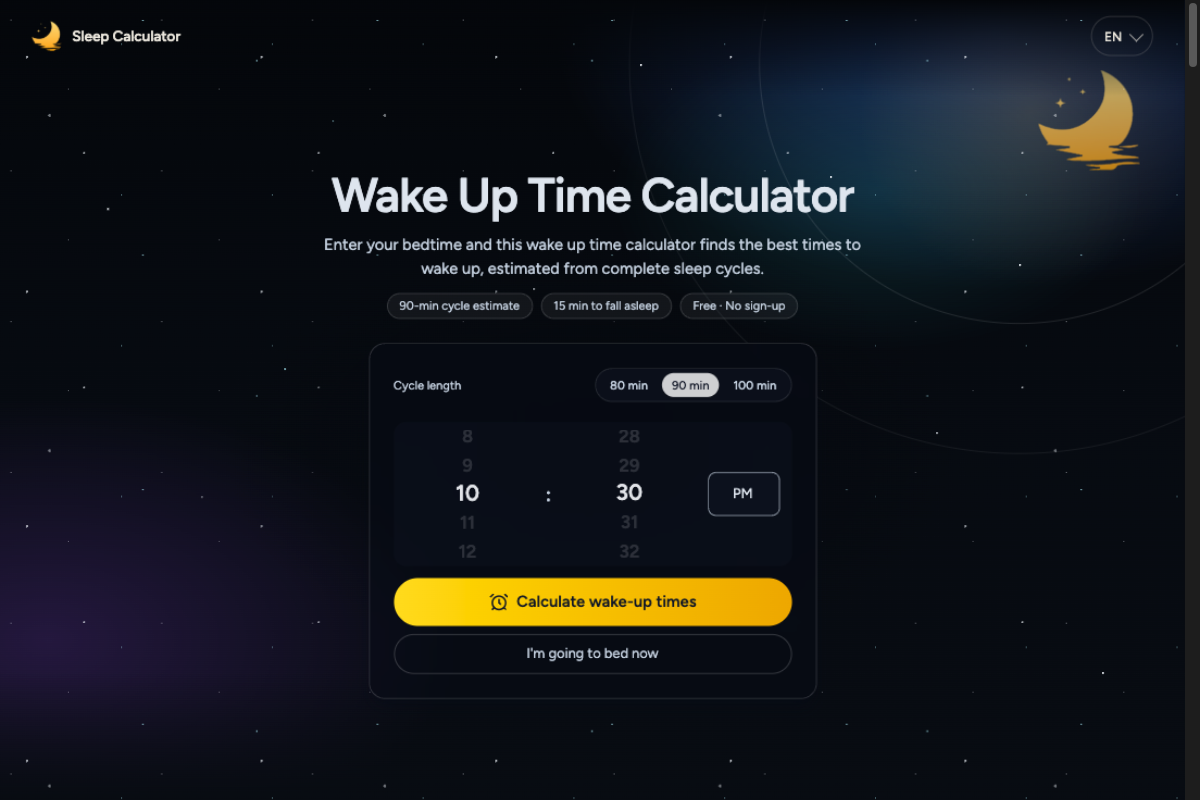
The wake up time calculator opens ready to plan a 10:30 PM bedtime. Get your wake-up times
Tap Calculate wake-up times and six options appear instantly, each labeled with its total hours of sleep.
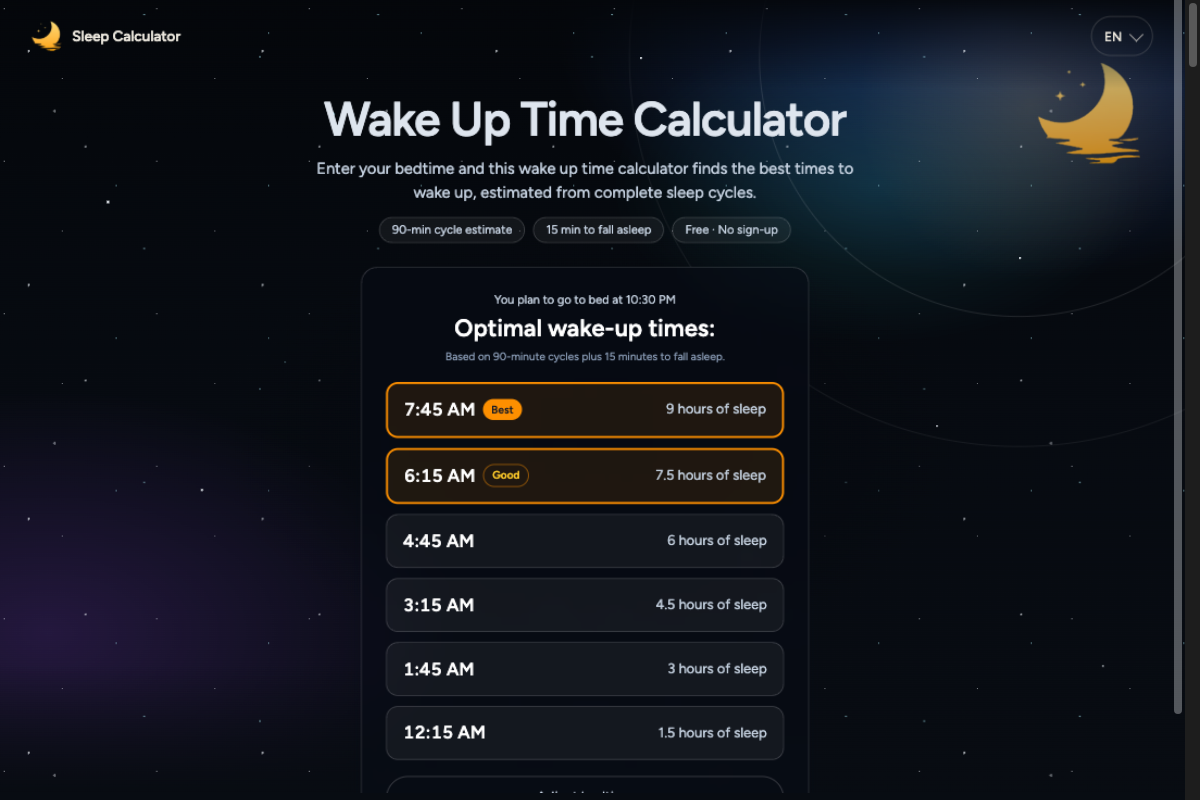
The two amber rows mark the healthiest wake-up times for most adults. Already in bed? Skip the wheels
Tap I'm going to bed now and the calculator uses your device's current time to jump straight to the results.
How the wake up time calculator works
What this wake up time calculator does with your bedtime, why cycles matter more than total hours, and how to read the wake-up suggestions.
How to use this page
Spin the hour, minute and AM/PM wheels to set the time you plan to go to bed, then tap Calculate wake-up times. The wake up time calculator returns six options, from about ten and a half hours of sleep down to two. If you are reading this in bed right now, tap I'm going to bed instead and the calculator will use your device's current time directly.
Why waking at a cycle end matters
Sleep moves in repeating cycles of roughly 90 minutes that pass through light sleep, deep sleep and REM sleep. Waking mid-cycle, usually from deep sleep, is what produces sleep inertia: that heavy, disoriented feeling that coffee barely touches. Waking at the end of a cycle, when sleep is naturally light, leaves you far more alert. The wake up time calculator targets those cycle boundaries rather than a fixed number of hours.
The 15-minute fall-asleep allowance
The time you enter is when you plan to be in bed, not when you will be asleep. The wake up time calculator adds a 15-minute buffer for falling asleep before it counts the cycles, which is why the first suggestion after a 10:30 PM bedtime is not exactly six or seven and a half hours later. If you normally fall asleep much faster or slower, shift your bedtime entry accordingly.
Picking the right option
The amber-highlighted rows are the strongest choices: six cycles (about 9.5 hours with the buffer) is the long, complete night, and five cycles (about 7.8 hours) matches the commonly recommended seven to eight hours for adults. Three cycles, around 4.8 hours, is a reasonable emergency minimum for one night but not a habit. Longer is not automatically better; consistency matters more than any single night.
Limits of a cycle-based estimate
Cycle length varies from roughly 80 to 100 minutes between people and across the night, which is why the wake up time calculator lets you switch the cycle length at the top. The estimate is simple arithmetic on averages and cannot see how you actually slept. If you wake exhausted at a cycle boundary night after night, or feel sleepy during the day despite enough hours, treat that as a reason to talk to a clinician.
Worked example: a 11:00 PM bedtime
Say you plan to go to bed at 11:00 PM using the default 90-minute cycles. The wake up time calculator adds the 15-minute fall-asleep buffer first, so the count starts from 11:15 PM. Six full cycles land at 8:15 AM with about 9 hours of sleep, five cycles at 6:45 AM with about 7.5 hours, and four cycles at 5:15 AM with 6 hours. If your alarm is fixed at 6:30 AM, none of those rows land exactly on it, and that is the point: moving your bedtime by twenty minutes, not your alarm, is what lines a cycle boundary up with the wake-up time you actually need.
Working back from a fixed alarm
Many readers run the calculation the other way: the alarm is immovable, and bedtime is the free variable. That is the job of a bedtime calculator, which takes your required wake-up time and counts backwards in cycles to suggest when to be asleep by. The two tools answer different questions: this page asks what your body gets from the bedtime you have chosen, while a bedtime calculator asks what you must do tonight to protect the wake-up time you have already promised someone. Use whichever matches the constraint you cannot move.
Naps, split nights and shift work
The same arithmetic works beyond a single main sleep. A 90-minute nap that runs a full cycle leaves many people feeling more rested than a ragged 40-minute doze, precisely because it ends on a cycle boundary. Shift workers on a two-sleep pattern can run the wake up time calculator once for the main block and once for the top-up nap, treating each as its own set of cycles. What the tool cannot do is judge circadian timing: a mathematically perfect eight hours slept at the wrong body-clock time still leaves night-shift workers measurably impaired, which is why cycle planning is a helpful layer on top of good light and schedule hygiene rather than a substitute for it.
Make the first minutes after waking easier
Waking at the end of a cycle lowers the odds of severe sleep inertia, but the first quarter hour still benefits from a little design. Put the alarm across the room so the exit from bed is immediate, get bright light within a few minutes of opening your eyes, and delay caffeine by an hour or so so it does not mask whatever residual drowsiness remains. Keep wake-up times consistent across the week, including the weekend; a calculator can only place the boundary, and a stable schedule is what makes hitting it repeatable.
Wake up times for common bedtimes
The most requested bedtimes, using 90-minute cycles plus the 15-minute fall-asleep buffer.
Wake-up times by bedtime, assuming 90-minute cycles: six cycles is about 9 hours of sleep, five about 7.5.
- Bedtime
- 9:00 PM
- 6 cycles
- 6:15 AM
- 5 cycles
- 4:45 AM
- Bedtime
- 9:30 PM
- 6 cycles
- 6:45 AM
- 5 cycles
- 5:15 AM
- Bedtime
- 10:00 PM
- 6 cycles
- 7:15 AM
- 5 cycles
- 5:45 AM
- Bedtime
- 10:30 PM
- 6 cycles
- 7:45 AM
- 5 cycles
- 6:15 AM
- Bedtime
- 11:00 PM
- 6 cycles
- 8:15 AM
- 5 cycles
- 6:45 AM
- Bedtime
- 11:30 PM
- 6 cycles
- 8:45 AM
- 5 cycles
- 7:15 AM
- Bedtime
- 12:00 AM
- 6 cycles
- 9:15 AM
- 5 cycles
- 7:45 AM
- Bedtime
- 12:30 AM
- 6 cycles
- 9:45 AM
- 5 cycles
- 8:15 AM
- Bedtime
- 1:00 AM
- 6 cycles
- 10:15 AM
- 5 cycles
- 8:45 AM
Five cycles fits the seven to eight hours most adults need; take six when the extra night is available. Between rows, set the exact minute in the calculator above.
Wake up time calculator FAQ
Quick answers to the questions we hear most.
What is the best time to wake up?
How accurate is the 90-minute rule?
Why do I still feel groggy after enough sleep?
Can I use the wake up time calculator for naps?
Sources & references
Each claim on this page is checked against the public guidance below. The links open the original source; none of them are affiliate or sponsored links.
- AASM & SRSRecommended Amount of Sleep for a Healthy Adult: A Joint Consensus Statement (2015)
- CDCAbout Sleep — how much sleep is recommended by age (2024)
- Ip MV, et al.A retrospective study of ultradian sleep cycles: frequency and duration. Sleep Health (2024)
- NINDSBrain Basics: Understanding Sleep
- NHSInsomnia — self-help tips and when to see a GP
- Hirshkowitz M, et al.National Sleep Foundation's sleep time duration recommendations: methodology and results summary (2015)
- Ramar K, et al. (AASM)Sleep is essential to health: an American Academy of Sleep Medicine position statement (2021)
- Strohl KP, et al. (ATS)Importance of Healthy Sleep: An Official American Thoracic Society Statement (2015)
- Hilditch & McHill, 2019Sleep inertia: current insights, Nature and Science of Sleep
- Sleep FoundationSleep Cycles and the Stages of Sleep
- Sleep FoundationREM Sleep: What It Is and Why It Matters
- Sleep FoundationAlcohol and Sleep
- Sleep FoundationHow Much Sleep Do You Really Need?
Sleep Calculator is an informational tool, not a medical device. It does not diagnose or treat any condition, and the times it suggests are estimates based on population averages. If poor sleep persists for several weeks, or you feel sleepy during the day despite spending enough time in bed, contact a healthcare professional.